Google’s November 2026 Core Update: How to Audit Your Website Content
TL;DR
- Google started rolling out its November 2026 core update on 10 November. It may take up to two weeks to complete.
- It’s the first core update since Google updated its guidance on helpful and AI-generated content in October.
- Google doesn’t penalise AI content, but it expects every page to be reviewed, fact-checked and genuinely useful.
- Don’t rush to rewrite pages. Wait until the rollout ends, compare your Search Console data, then audit your most important pages first.
Google’s November 2026 core update is rolling out right now, and it’s the first big ranking shake-up since Google rewrote its content guidelines. If your traffic depends on a handful of key pages, this is the moment to make sure they hold up.
Google has been putting more emphasis on content quality and accuracy, particularly when AI is involved. For businesses publishing content regularly, it’s a useful reminder to review what’s going live rather than treating AI-generated drafts as finished articles. The important thing is making sure your content is accurate, useful and offers something beyond what competitors are already saying.
What Google changed last month
In the first week of October, Google quietly updated two of its most important documentation pages. Neither change was an algorithm update, but together they spell out exactly what Google now expects from publishers.
October 1. The generative AI content guide. Google now says it’s critical to manually fact-check and review all AI-generated content for accuracy and trustworthiness before publishing. Crucially, that review now explicitly covers the bits nobody looks at: title tags, meta descriptions, structured data and image alt text, all of which can appear in search results.
October 2. The helpful content guide. Google’s “Creating helpful, reliable, people-first content” page gained new sections on main content, effort, skill and accuracy, plus a warning that fake author profiles (AI headshots, invented names, made-up credentials) are a form of deception.
If you’re familiar with E-E-A-T (experience, expertise, authoritativeness and trustworthiness), the direction will feel familiar. Both updates put more weight on real expertise and on content readers can trust. We’ve covered how E-E-A-T works and how to show it on your website in more detail.
For businesses using AI to support their content production, this doesn’t mean changing everything. It means having a proper review process before anything gets published.
Why this core update matters
Google started rolling out the November 2026 core update on November 10 and says it may take up to two weeks, which puts completion around November 24. It applies globally and to all languages.
It’s the third core update of 2026, after March and May, and the first since the May update finished on June 2. That also makes it the first core update since the October guideline changes went live.
Google calls it a regular update designed to better surface relevant, satisfying content, and it hasn’t said the update specifically targets AI content. But core updates reassess quality across the board, and the guidelines tell you what Google means by quality right now. If your pages fall short of them, this is when it’s most likely to show up in your rankings.
The timing adds pressure too. A full rollout ends just days before Black Friday, so any visibility swings will land in the busiest trading week of the year.
What we look for in a website content audit
Google doesn’t publish a checklist of ranking signals, and the criteria below aren’t one. They’re the practical questions we use when we audit a client’s content, informed by Google’s helpful content and AI guidance.
| Criterion | What we look for | Ask yourself |
|---|---|---|
| Originality | Your own research, data, analysis or perspective | Does this page say anything competitors’ pages don’t? |
| Content effort | Clear signs of time and care, not mass-produced text | Could someone tell a human actually worked on this? |
| Helpfulness | A complete answer that leaves readers satisfied | Would a reader need to search again after reading? |
| Talent or skill | Expertise and craft in the writing, visuals or tools | Is this written by someone who knows the subject? |
| Accuracy | Facts, stats and claims checked against real sources, metadata included | Has every number, date and name been verified? |
| Trust | Real, named authors and transparent sourcing | Would you be comfortable showing who wrote this and why? |
| People-first intent | Written to help a reader, not to rank | Would you publish this page if search engines didn’t exist? |
| Spam signals | No scaled filler, keyword stuffing or fake profiles | Is anything here designed to game Google rather than help? |
If a page falls short on more than one of these, it’s a good candidate for review.
How to audit your top landing pages now
You don’t need to review your whole site this week. Start with the pages that drive the most traffic and revenue.
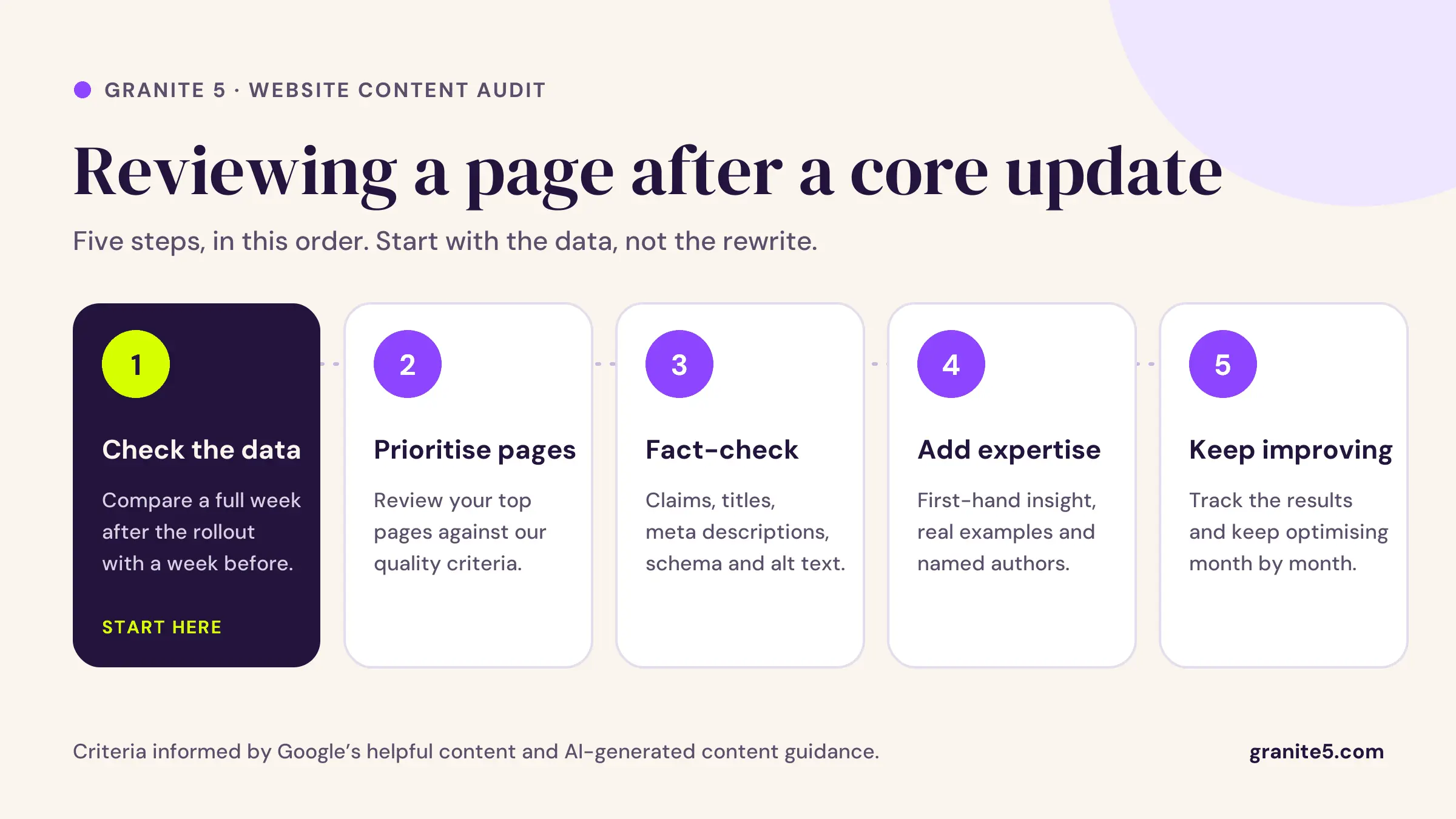
- Pick your top 20 pages. Pull them from Search Console by clicks over the past three months, and add any page that’s critical for holiday sales.
- Fact-check everything. Verify every statistic, date, name and quote against a primary source. Then check the title tag, meta description, schema and alt text too, since Google now names these explicitly.
- Check the byline. Make sure every author is a real person with a genuine bio. Remove or fix any invented names, stock headshots or vague credentials.
- Add what only you can add. Look for places to include first-hand experience, original photos, your own data, customer examples or expert commentary.
- Cut the filler. Remove padded intros, repeated points and generic sections that exist only to target keywords. Our guide to improving user experience through great content has more on writing for readers first.
- Annotate, then wait. Note November 10 in your analytics. Google advises waiting at least a full week after the rollout ends, then comparing that week with one before it started, rather than reacting to day-to-day swings.
The bottom line
We wouldn’t recommend making major changes to your website just because Google has announced an update. First, look at the data. If important pages have lost visibility, investigate why before deciding what needs to change.
“When a core update lands, the temptation is to start rewriting pages straight away. We always look at the data first. In Search Console, compare a full week after the rollout with a week before it, page by page. If a page has dropped, read it the way your customer would and ask whether it’s still the most useful answer to their question. That tells you far more than any checklist.”
Sue Roochove, Managing Director, Granite 5
Whatever the data shows, it’s worth reviewing your most important pages against Google’s updated guidance. Check they’re accurate, useful and offer something competitors don’t.
Frequently asked questions
Does Google penalise AI-generated content?
No. Google’s guidance focuses on the quality of content, not how it was produced. AI-assisted content is fine if it’s reviewed, fact-checked and genuinely useful. Problems arise when AI is used to mass-produce pages with little or no human oversight.
Do I need to update my website content regularly?
Not for the sake of it. Updating a page only helps if it makes it more accurate or more useful. Prioritise pages that matter to your business, have lost visibility, or contain information that’s gone out of date. Our guide to 14 reasons to update your website covers the signs it’s time.
Is content quality the only thing that matters?
No. Technical health still matters too. If pages load slowly or are hard to use on a phone, good content has to work harder. Our 5-step website health check and guide to Google’s Core Web Vitals are good places to start.
Will this affect how I appear in Google’s AI Overviews?
Google hasn’t linked this core update specifically to AI Overviews. But accurate, clearly structured content written by people who know the subject is more likely to be useful wherever Google shows it. We’ve written about how to win back clicks from AI Overviews.
Granite 5 can help you apply the new rules
Start with the pages that matter most to your business. Here’s what to do, and how we’ll help you do it.
- Find out which pages are at risk. List your top landing pages and review each one against the criteria above. We’ll run the audit with you and tell you which pages to fix first.
- Fact-check everything that ranks. Check every claim on the page, plus the titles, meta descriptions, schema and alt text. We’ll work through the checks with your team and correct what’s wrong.
- Find where your expertise counts. We can review your existing content alongside Search Console performance to identify pages worth improving, opportunities you’re missing and where your team’s expertise could make the biggest difference.
- Measure, then keep improving. Compare your Search Console data once the rollout settles, then keep optimising. Our Digital Growth Service brings strategy, SEO, content, paid campaigns, conversion and data together in one ongoing programme, so your site keeps up as Google’s standards change. We explain the thinking behind this in how continuous improvement drives business growth.
For an example of this work in practice, see our Millworks website optimisation case study.
Start with your top pages this week
Talk to the Granite 5 team and we’ll show you where to begin with a website content audit, and how our Digital Growth Service can keep your site improving as Google’s standards change.
About the author
Jack Greenacre is Digital Account Director at Granite 5, a Cambridge web design and digital marketing agency, where he leads the Digital Growth Service.
Sources
- Search Engine Journal: Google’s November 2026 core update starts rolling out
- Search Engine Roundtable: Google November 2026 core update rolling out
- HigherVisibility: Google’s AI content guide now calls manual fact-checking critical
- PPC Land: Google’s content quality guidance turned into 83 checks
- Google’s October 2026 AI content guidelines, explained